
Educator qualifications and ratios: what to check
By Marcus Quinn, Head of Research · Updated 2026-11-08
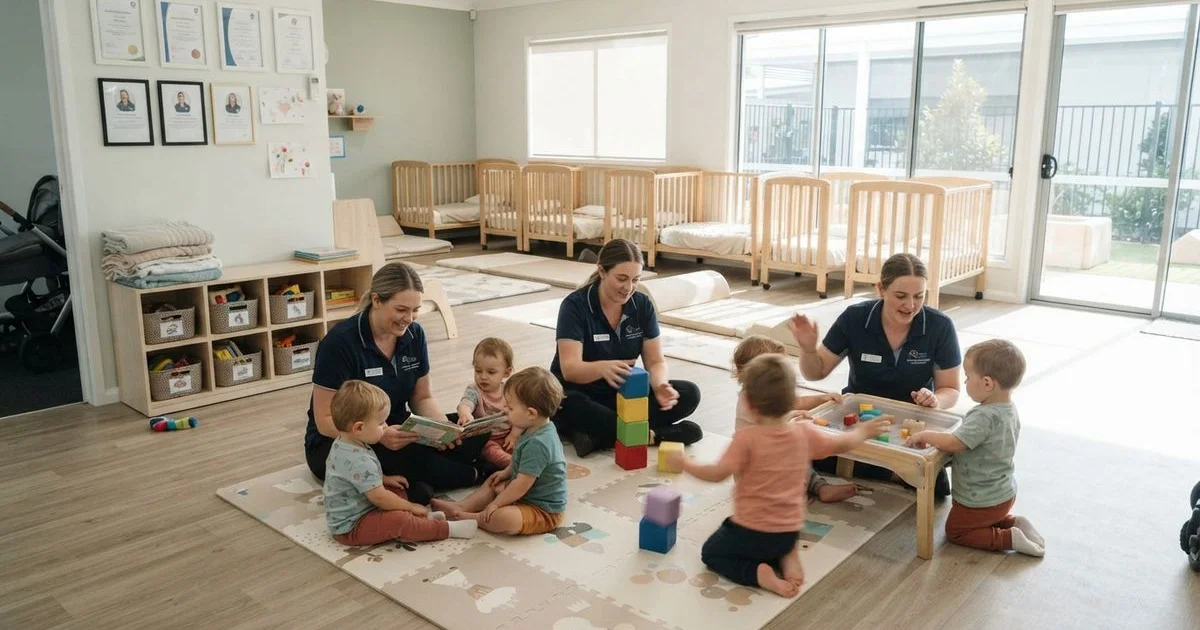
A ratio sounds like something you can count from the doorway. In Queensland it is calculated across the whole service, not room by room, and only educators working directly with the children count. That changes what you can learn on a tour, and what you should ask.
Queensland educator-to-child ratios for centre-based care, set by the National Regulations, are 1 educator for every 4 children from birth to 24 months, 1 for every 5 from 24 months to under 36 months, 1 for every 11 from 36 months to preschool age and 1 for every 15 over preschool age. At least 50% of the educators needed to meet those ratios must hold, or be actively working towards, a diploma or higher. All the others needed for the ratios must hold, or be working towards, a certificate III.
What are the Queensland ratios by age?
The ratios are minimums set in the Education and Care Services National Regulations, which apply in Queensland. Services can staff above them.
| Age of child | Minimum ratio |
|---|---|
| Birth to 24 months | 1 educator to 4 children |
| 24 months to under 36 months | 1 educator to 5 children |
| 36 months to preschool age | 1 educator to 11 children |
| Over preschool age (school-age care) | 1 educator to 15 children |
A child is over preschool age once they attend school in the year before Grade 1 or later, so a Prep child counts as school age. Mixed-age groups must meet the ratio for each age group at all times. In family day care, an educator can care for no more than 7 children at once, with no more than 4 of them preschool age or under.
Can you check a ratio on a tour?
Only partly. The ratios of 1:4, 1:5, 1:11 and 1:15 are calculated across the whole service, so the number of educators in 1 room on 1 morning does not show whether the service meets them. Only educators who are physically present and directly involved in education and care count towards them.
A room that looks well staffed on the day can still be at its minimum, and a busy room can be above it. You can learn a lot by asking how the roster works, and what the service’s own staffing target is for that age group. Ask how the service covers breaks, how it covers an educator who is away, and who is counted when children move between rooms and the yard.
What qualifications must educators hold?
In a centre-based service with children preschool age or under, at least 50% of the educators needed for the ratios must be diploma level or higher. The rest must hold a certificate III. “Actively working towards” counts for both, so some educators in a room may be mid-study.
3 other rules shape who is in the building:
- A new family day care educator must hold a certificate III before starting.
- For school-age care, Queensland also requires at least 1 educator with, or working towards, a 2 year relevant qualification to be present, for at least 7 hours and 15 minutes of the day at a service that operates longer.
- An early childhood teacher is required at centre-based services, and the requirement grows with size. A service with fewer than 25 approved places needs access to a teacher for at least 20% of the time. Where 25 to 59 children attend and the service operates 50 or more hours a week, a teacher must be in attendance for at least 6 hours that day.
In the opening hours listed on Google, checked 8 November 2026, 16 of the 21 Redland Bay services in our directory list a 12-hour day, which is 60 hours across 5 days (our arithmetic). Services that operate 50 or more hours a week fall into the 6-hour teacher rule on days when 25 to 59 children attend. Ask a centre how it meets the 6-hour teacher rule.
Who is in charge when you visit?
Educator qualifications and ratios are only part of the picture: a centre-based service must also have a responsible person present whenever children are in care. That is the approved provider, a nominated supervisor, or a person put in day-to-day charge. Every approved service must have at least 1 nominated supervisor, who must be at least 18, give written consent and have adequate knowledge and understanding of education and care. Some older guides still mention certified supervisors, but that role was removed from the National Law on 1 October 2017.
A service must display its nominated supervisors and the name and position of the responsible person in charge at any given time, so look for that display when you arrive.
What should you ask on a tour?
Check educator qualifications and ratios by asking these questions about your child’s age group and room, and write the answers down:
- Which ratio does the service work to for that age group, and how does it count educators at the start and end of the day?
- What share of the educators in that room hold a diploma, a certificate III or are working towards one?
- Who is the early childhood teacher, and on which days are they in the room?
- Who are the nominated supervisor and today’s responsible person?
- How long have the educators in that room worked there, and who covers when one is away?
Write the answers down and ask the same questions at each centre, because a room that sounds confident can still rely on educators who are mid-study.
For the bigger picture of how staffing fits into a service’s rating, see childcare quality ratings and regulations in Queensland. Quality area 4 of the National Quality Standard covers staffing arrangements, and the rating shows how the regulator assessed it.
Common questions
- What is the educator-to-child ratio for babies in Queensland?
- In a Queensland centre-based service the minimum ratio is 1 educator to 4 children from birth to 24 months. From 24 months to under 36 months it is 1 educator to 5 children, from 36 months to preschool age it is 1 to 11, and over preschool age it is 1 to 15. Services can staff above these minimums.
- Are ratios worked out room by room?
- No. Ratios are calculated across the whole service, not by individual rooms. Only educators who are physically present and directly involved in education and care count towards them. For mixed ages, the service must meet the ratio for each age group at all times, although the youngest age group's ratio is not applied to the older children.
- Does every educator need a diploma?
- No. In a centre-based service with children preschool age or under, at least 50% of the educators needed to meet the ratios must hold, or be actively working towards, a diploma or higher. All other educators needed for the ratios must hold, or be working towards, a certificate III. So a certificate III is the minimum, not a leadership credential.
- What ratio applies to before and after school care in Queensland?
- For children over preschool age the Queensland ratio is 1 educator to 15 children. Queensland also requires at least 1 educator holding, or working towards, a minimum 2 year relevant qualification to be present. Where 30 or more school-age children attend, 1 educator for every 30 must hold, or be working towards, a minimum 1 year relevant qualification.