Health and safety standards to check in a childcare centre
By Marcus Quinn, Head of Research · Updated 2026-11-08
A tour shows you a yard and a room. It does not show you the policies behind them, and in Queensland many of the legal duties sit in those policies. This guide lists what the regulations require, so you know which questions have a legal answer and which are a judgement call.
Queensland childcare health and safety duties come from the National Regulations. A centre must have a medical conditions policy, a sun protection policy, an infectious diseases policy and adequate shade. It must always have staff on site with first aid, anaphylaxis and asthma training, and it must tell you within 24 hours about any incident, injury, trauma or illness involving your child.
What do the regulations require?
The table covers the childcare health and safety standards parents ask about most. Each is a requirement on the service, not a recommendation.
| Area | What a Queensland service must do |
|---|---|
| Sun protection | Provide adequate shaded outdoor areas, and have sun protection policies and procedures. |
| Medical conditions | Have a medical conditions policy covering asthma, diabetes and anaphylaxis risk, and give you a copy if your child has an allergy or medical condition. |
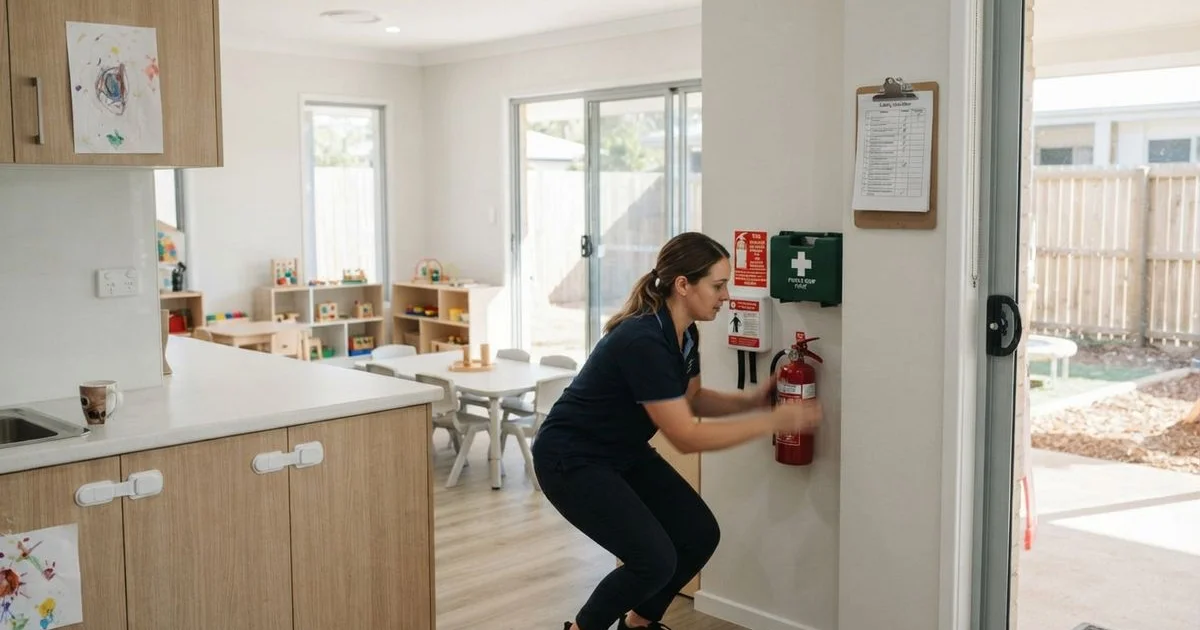
| First aid | Always have at least 1 staff member immediately available with current first aid training, 1 with anaphylaxis management training and 1 with emergency asthma management training. |
| Infectious disease | Have an infectious diseases policy, and tell the parent or emergency contact of each child about an occurrence as soon as practicable. |
| Incidents | Tell the parent of a child involved in an incident, injury, trauma or illness within 24 hours, and record the details within 24 hours. |
A service that meets a duty can show you the policy, the plan or the record behind it. Ask to read the document rather than accept a verbal answer, and note which of these your child’s age or condition makes most relevant.
What should a sun protection policy say?
Sun protection is one of the childcare health and safety standards that applies every day, because the UV Index in Queensland is 3 or above all year round. A service has to provide adequate shade, and the hat and sunscreen rules come from its own policy.
The 2 main sources differ on sunscreen, so ask which one a centre follows:
- The Queensland Government advises a broadbrim or bucket style hat covering the head, neck and ears, and broad-spectrum sunscreen of SPF30 or higher, reapplied regularly.
- Cancer Council Queensland’s 2024 policy guide for early childhood services recommends SPF50 or SPF50+ water-resistant sunscreen, applied 20 minutes before going outdoors and reapplied every 2 hours.
The same Cancer Council template says outdoor activities should be scheduled to minimise time outdoors when the UV index is 6 or above, whenever practical. For children under 12 months, it says they should not be exposed to direct sunlight when the UV index is 3 or above, a line the template marks “if applicable”. A SunSmart sign is recognition from Cancer Council Queensland, not a legal requirement.
What must a centre do about medical conditions?
The childcare health and safety standards for allergies and medical conditions start with paperwork. If your child has an allergy or another relevant medical condition, the centre’s policy must require you to provide a medical management plan and require staff to follow it. The centre must also develop a risk minimisation plan with you and a communications plan. The risk minimisation plan covers safe food handling, telling you about known allergens, and making sure all staff can identify your child, their plan and where the medication is.
A serious reaction, severe asthma attack or seizure that needs hospital is a serious incident. The service must tell you within 24 hours and notify the regulator within 24 hours. The 2026 update to the national anaphylaxis guidelines uses the term “adrenaline devices”, so ask which adrenaline devices the centre holds and who is trained to use them.
Who is allowed around the children?
Blue cards are among the childcare health and safety standards that decide who may be around the children. Queensland’s blue card is the Working with Children Check. It looks at more than a police check, and card holders are monitored every day. A card is valid for 3 years.
Most adults who enter a childcare service while children are there need a blue card. That includes staff, volunteers, cleaners, cooks, tradespeople and students on placement. It does not include parents dropping off or collecting a child. A Queensland registered teacher needs an exemption card, which is a type of blue card, to work in a kindergarten or childcare centre. Ask how the centre checks that contractors and visitors who come in during the day have a card.
What 6 questions should you ask on a tour?
To check childcare health and safety standards on a tour, ask for these and ask to see the documents behind the answers:
- Ask to read the sun protection policy and the medical conditions policy.
- Ask which sunscreen and hat rules the centre follows, and what time children go outside on a high UV day.
- Ask who holds first aid, anaphylaxis and asthma training on today’s roster.
- Ask how and when parents are told about an incident, and what is recorded.
- Ask where the shade is, and where an educator can stand to see the whole yard.
- Ask how the centre checks the blue card of a relief educator who covers an absence.
For infectious disease and exclusion periods, our illness and exclusion guide covers what to expect.
What can a tour not tell you?
A tour shows you childcare health and safety standards on 1 day. The regulator’s record covers more than 1 day, and our quality ratings guide explains where to find it. Our own directory score is built from 5 review and listing signals, and none of them measures safety or compliance. Our method page says reviews are not inspections (checked 8 November 2026).
Common questions
- What sun protection should a Queensland childcare centre have?
- Among the childcare health and safety standards, a centre must provide adequate shaded outdoor areas and have sun protection policies and procedures. The UV Index in Queensland is 3 or above all year, so the policy should run all year. The Queensland Government advises broadbrim or bucket hats and SPF30 or higher sunscreen. Cancer Council Queensland recommends SPF50 or SPF50+ for services. Ask which one the centre follows.
- What must a childcare centre do about my child's allergy?
- The centre's medical conditions policy must require you to give a medical management plan, and staff must follow it. The centre must also develop a risk minimisation plan with you, covering safe food handling and telling you about known allergens, plus a communications plan. At least 1 staff member trained in anaphylaxis management must always be on site and immediately available.
- Do childcare staff need a blue card?
- Most adults who enter a childcare service while children are there need a blue card, including staff, volunteers, cleaners, cooks, tradespeople and students on placement. Queensland registered teachers need an exemption card, which is a type of blue card. Parents dropping off or collecting a child do not need one. A blue card is valid for 3 years, and holders are monitored every day.
- Will a childcare centre tell me if my child is hurt?
- Yes. A service must tell the parent of a child involved in an incident, injury, trauma or illness within 24 hours, and record the details within 24 hours. A serious incident, such as an injury needing urgent medical attention or hospital, must also be reported to the regulator within 24 hours by the approved provider.