
Illness and exclusion policies: what new childcare parents should know
By Marcus Quinn · Updated 2026-08-05
This is general information, not medical advice; a GP is the right source for guidance on your child’s specific symptoms or return-to-care timing.
Every family with a child in group care eventually deals with the phone call: your child has symptoms, and you need to collect them. Knowing the general pattern in advance makes the actual moment considerably less stressful.
Why exclusion policies exist
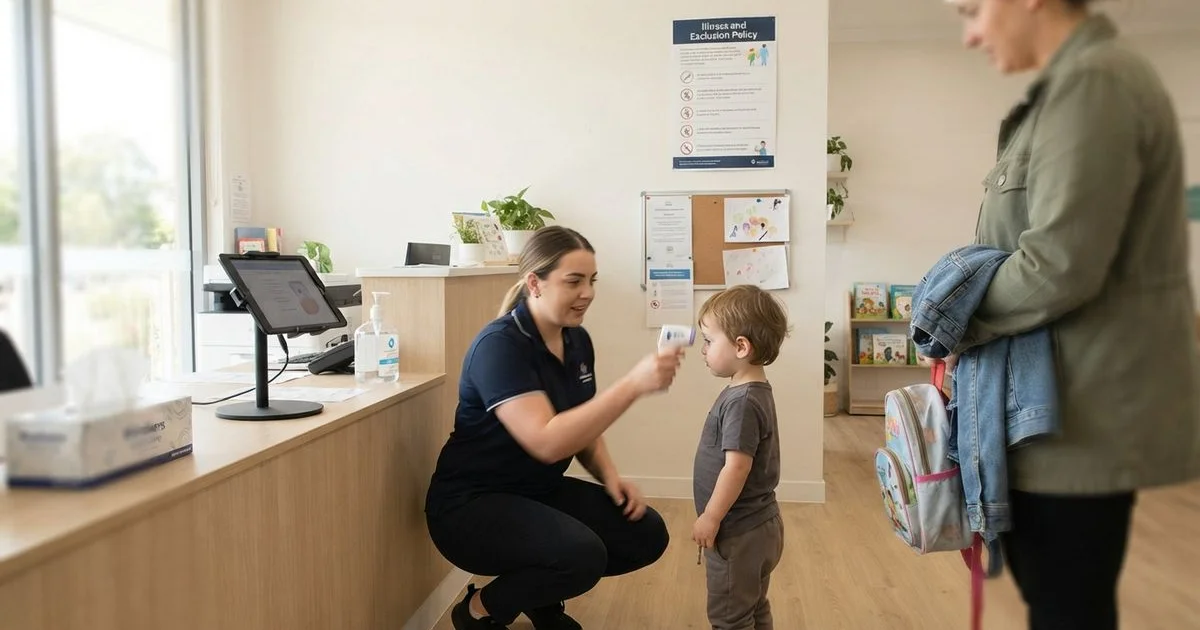
Centres exclude unwell children primarily to limit the spread of illness through a group setting, where children spend close, sustained time together. It can feel inconvenient in the moment, but the same policy is protecting your own child from exposure on the days someone else is unwell. Illness policy is only one part of a centre’s overall approach; our guide to health and safety standards to check in a childcare centre covers supervision, hygiene and outdoor safety more broadly.
Common reasons for exclusion
- Fever above a set threshold, usually alongside other symptoms
- Vomiting or diarrhoea, generally requiring a symptom-free period before return
- Contagious conditions like conjunctivitis, hand, foot and mouth disease, or chickenpox, often with a specified exclusion period
- Significant coughing, congestion or general unwellness that would make it hard for a child to participate normally
Every centre operates from published health guidelines and can give you their specific list on enrolment. Ask for this in writing rather than relying on memory later.
What a typical exclusion period looks like
| Condition type | General pattern |
|---|---|
| Fever | Excluded until fever-free for a set period without medication |
| Vomiting or diarrhoea | Excluded until symptom-free for a set period, often 24 hours |
| Conjunctivitis | Excluded until treatment has started or symptoms have cleared |
| More serious infectious illness | May require a doctor’s clearance before returning |
Exact timeframes are set by public health guidance and can be confirmed with the centre or your GP.
Planning for the inevitable
Most families underestimate how often a young child in a new group setting will pick up something in the first several months. It is common, not a sign that anything is wrong with the centre or your child’s immune system, and it typically settles down as exposure builds over time.
Practical steps that help:
- Have a backup care plan in place before you need it, whether that is a partner, family member or flexible work arrangement.
- Ask about fee policies for sick days upfront, since most centres still charge to hold the spot.
- Keep a small bag of spare clothes and any regular medication information on file with the centre.
Communication during illness
Ask how the centre communicates outbreaks, such as gastro moving through a room, so you can watch for early symptoms at home. Centres that flag this proactively, rather than only when directly asked, tend to help families plan ahead rather than being caught out.
Medication at the centre
If your child needs regular medication, such as for asthma or an allergy, most centres require a written management plan from your GP before they will administer anything, along with clearly labelled medication kept on site. Sort this out during enrolment rather than waiting for the first time it is actually needed, since some centres will not administer medication without the paperwork already on file, even in an urgent moment.
Allergies and food-related exclusions
Centres with a meal service generally ask for a detailed allergy and dietary profile as part of enrolment, and many now operate with specific allergen restrictions across a whole room to protect a child with a severe allergy. If your child has a known allergy, ask how the centre manages it in practice: how meals are checked, how other children’s food brought from home is handled, and what the emergency response plan looks like if an exposure happens.
Returning after illness
Some conditions require a set exclusion period regardless of how your child seems day to day, and a few require medical clearance before return. Confirm the exact requirement with the centre rather than guessing, since getting it wrong can mean being turned away at drop-off on a day you had planned around.
Our ranking methodology covers how clearly centres communicate policies like this as part of our scoring. You can compare centres from the homepage as you weigh up your options.
Common questions
- Will I still pay fees on days my child is excluded for illness?
- In most cases, yes, since the enrolment spot is still held for your child. Ask each centre for their specific policy on sick day fees before you enrol.
- How much notice will I get before I need to collect a sick child?
- Usually very little. Centres typically call as soon as a child shows symptoms requiring exclusion, so it helps to have a backup plan for last-minute pickup.
- Do I need a doctor's certificate to return after some illnesses?
- Some conditions require medical clearance before a child can return, particularly more serious infectious illnesses. The centre will tell you which conditions apply this to.
- Why do children seem to get sick so often in their first year of care?
- Group settings expose children to more illnesses than they would encounter at home, and it is common for exposure, and immunity, to build up noticeably in the first several months.