
How family day care works, day to day
By Marcus Quinn · Updated 2026-07-06
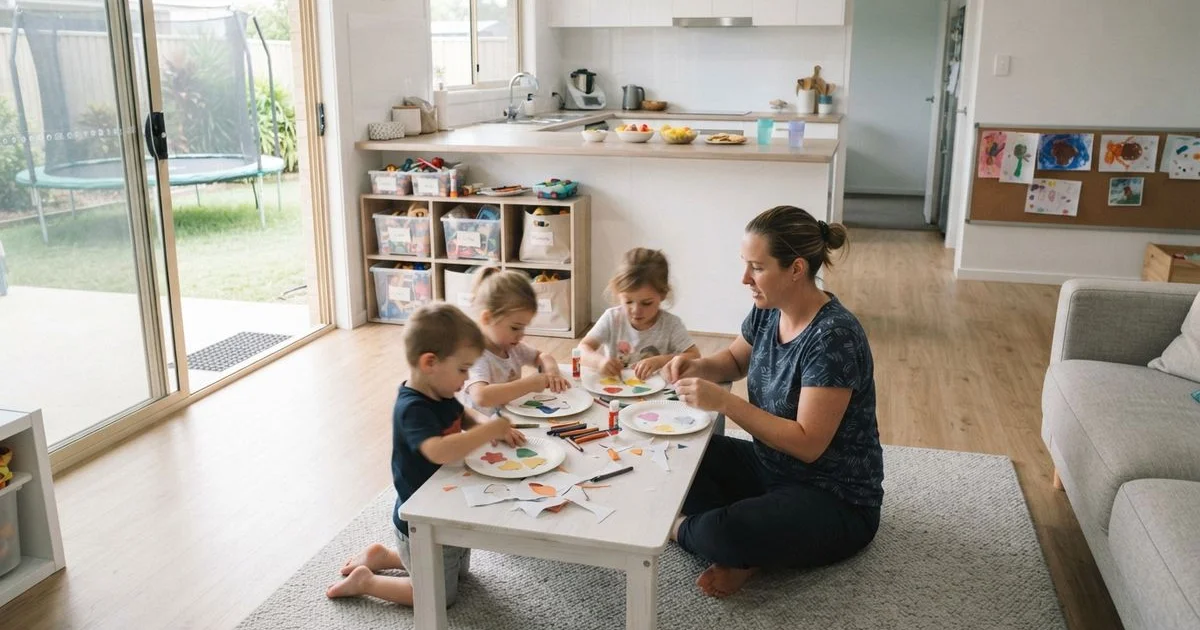
Family day care gets less attention than centre-based care, partly because it looks less uniform from the outside. Every educator runs their own home, so no two settings look identical, which makes it worth understanding the structure before you compare specific options.
If you are ready to compare, family day care listings in Redland Bay are a reasonable next step once you know what questions to ask.
What family day care actually is
A family day care educator is a registered childcare professional who cares for a small group of children, usually mixed in age, from a home-based setting. Educators are approved and monitored through a family day care service, which handles registration, quality checks and administrative support, so it is not an informal arrangement even though it happens in a home.
A typical day
Structure varies more than in a centre, since it depends on the educator’s own approach, but most days include:
- a morning routine of free play, outdoor time and a planned activity
- meals and snacks, either provided by the educator or brought from home depending on the arrangement
- rest or quiet time for younger children
- pick-up conversations that tend to be more detailed than a centre handover, since the group is smaller
| Family day care | Long day care centre | |
|---|---|---|
| Setting | Home-based | Purpose-built centre |
| Group size | Small, mixed ages | Larger, age-grouped rooms |
| Educator | One primary educator per group | Rotating team across rooms |
| Flexibility | Often more flexible on hours | Set opening hours, less flexible |
Neither is universally better. Some families prefer the smaller group and consistent educator; others prefer the structure and staffing depth of a centre.
Questions worth asking before you enrol
- What backup arrangement is in place if the educator is unavailable?
- How does the educator handle mixed-age activities, so a toddler and a school-aged sibling are both engaged?
- What does a typical week of meals and outings look like?
- How often does the coordinating service visit or review the home?
A registered educator should be able to answer all of these clearly and without hesitation. Vague answers about backup care in particular are worth following up on, since a single-educator model has less built-in redundancy than a centre.
Cost and subsidy
Family day care is an approved care type under the Child Care Subsidy, so the same income and activity-based rules apply as they would for a centre. Daily fees for family day care tend to run a touch lower than centre-based care on average, though it varies by educator, so it is worth comparing an actual quote rather than assuming a discount.
How registration and oversight work
A registered family day care educator does not operate independently in the way a private nanny would. They work under a coordinating family day care service, which handles their registration, runs regular home visits and quality checks, and provides administrative and programming support. This oversight layer is part of what separates registered family day care from an informal babysitting arrangement, and it is worth confirming the coordinating service’s name and asking how often they visit as part of your own due diligence.
What a settling-in period looks like
Most family day care educators offer a short settling-in visit or two before a child’s official start date, similar to a centre, though it often feels more personal given the smaller group. Because the setting is a home rather than a large facility, some children who find bigger group environments overwhelming settle in noticeably faster with a family day care educator. Ask the educator what their usual settling-in process looks like, since it varies more between individual educators than it does between centres.
Is it the right fit
Family day care tends to suit families who want a smaller, more home-like environment, flexible hours, or care for siblings of different ages together in one place. It suits some children better than a larger centre, and vice versa; there is no universally correct answer, only the fit for your child and your routine. If you are already thinking ahead to a centre later on, moving from family day care to a long day care centre covers what that switch involves, and what to expect when your child starts long day care walks through the first weeks once you get there.
Our ranking methodology treats family day care and centre-based options on the same scoring criteria, communication, consistency and family feedback, so you can compare fairly across both. You can also start from the homepage to see every care type available in Redland Bay in one place.
Common questions
- How is family day care different from a centre?
- Family day care is run by a registered educator from a home-based setting, usually with a smaller group of children across mixed ages, rather than the room-based structure of a long day care centre.
- Is family day care eligible for the Child Care Subsidy?
- Yes, family day care is an approved care type, so the same subsidy rules apply as they do for a centre, based on your income and activity level.
- What happens if my educator is sick or takes leave?
- Registered family day care schemes usually have a backup arrangement, either another educator in the scheme or a coordinator who helps arrange alternative care. Ask about this before you enrol.
- Can my child be in mixed age groups all day?
- Yes, that is the normal structure in family day care. Educators plan activities that work across ages, and many families see it as a benefit rather than a drawback, since siblings can often attend together.