
What to expect when your child starts long day care
By Marcus Quinn, Head of Research · Updated 2026-11-08
Starting long day care means paperwork, a subsidy claim and a run of small decisions before the first day. This guide covers the practical side: what to sort out before day 1, what happens at an orientation visit and what to ask about the daily routine.
Starting long day care in Redland Bay means 3 jobs before day 1: complete the centre’s enrolment form, claim the Child Care Subsidy, and book an orientation visit. Services Australia says to claim before your child starts care (How to claim Child Care Subsidy). All 18 long day care centres in our directory open between 6:00am and 6:30am on weekdays (Google hours, checked 8 November 2026), so a short first day fits inside their hours.
What paperwork does a childcare centre need?
A long day care centre needs 4 things from you before the first day: an enrolment form, your child’s Customer Reference Number (CRN), a care agreement and, if it applies, a medical plan. The form carries your child’s details and is also where the care agreement is set up. A child only has a CRN once a family has claimed a payment for them, such as Family Tax Benefit or Parental Leave Pay, so if your child has none yet you may need to wait for it after your subsidy claim is approved (Services Australia).
The care agreement is usually a Complying Written Arrangement: an agreement in writing between the centre and your family that sets out the care sessions and fees (Department of Education). The centre completes it, and your confirmed enrolment has to match it.
Check the days and fees on it before you sign.
If your child has an allergy or another medical condition, say so on the form. Every service must have a medical conditions policy. For a child with an allergy or a relevant condition it must require you to provide a medical management plan, and the service must develop a risk minimisation plan with you (National Regulations, regulations 90 and 91). The sources we read do not say the plan has to come from a GP, so ask the centre what it will accept.
The subsidy also needs your child to meet immunisation requirements (Services Australia).
Ask the centre which immunisation record it wants to see.
Setting up the Child Care Subsidy
The Child Care Subsidy is a separate step from the centre’s form, and it takes 2 actions with Services Australia, not the centre: 1 claim, then 1 confirmation of your child’s enrolment. You apply through your Centrelink online account linked to myGov. Anyone who cannot claim online can phone the Centrelink Families line.
Timing matters. A claim can only be backdated to the first Monday of a subsidy fortnight, no more than 28 days before you submit it (Services Australia). The subsidy is also only paid once you confirm your child’s enrolment in your Centrelink online account (Confirm enrolment). Ask the centre which day your enrolment starts, then confirm that same date in your account.
Services Australia pays the subsidy directly to the centre, which lowers the fee you are charged (Your income can affect it). Since 5 January 2026 the 3 Day Guarantee gives every eligible family at least 72 hours of subsidised care per child per fortnight, which is 3 days a week. It covers subsidised hours, not a place (Department of Education). Our guide to the subsidy percentage and your gap fee explains what you pay on top.
What happens at an orientation visit?
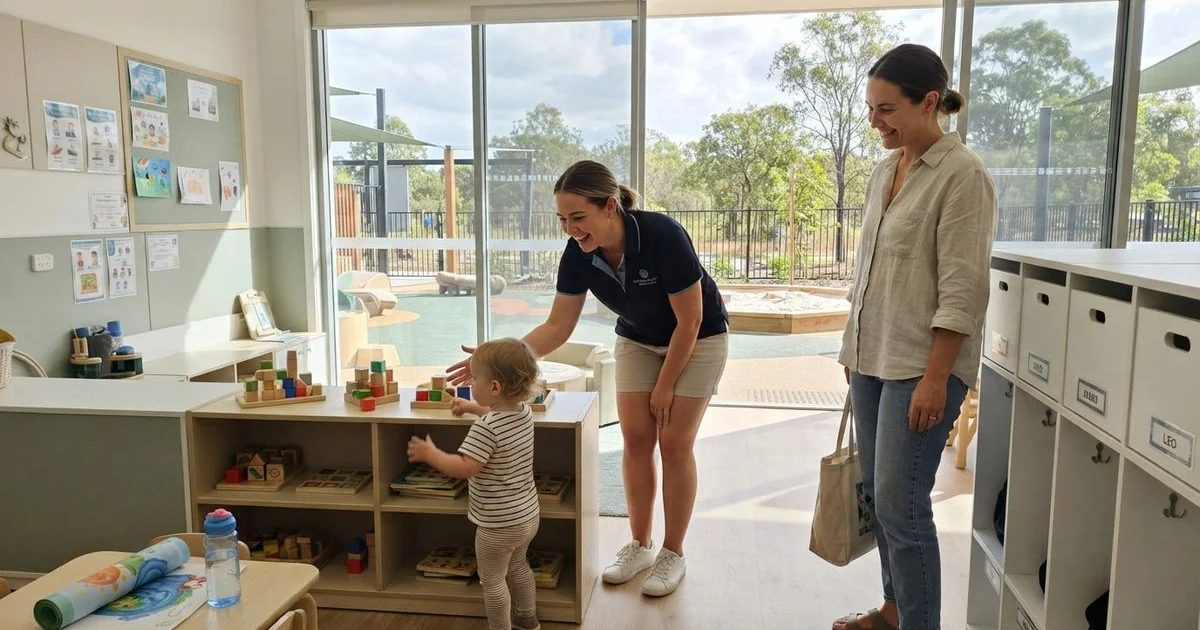
Plan at least 1 long day care orientation visit before day 1. It lets your child explore the room and start to know the educators, with you close by. The Australian Government’s Starting Blocks site recommends this, and suggests discussing your child’s interests, routines and rituals with the educators. The Queensland Government’s early childhood site also suggests visiting with your child so the space feels familiar.
Use the visit to ask 5 things:
- How many educators work in my child’s room?
- What does a normal day look like, and where does sleep fit?
- How do you apply your sun protection policy, and what should my child wear?
- What is your illness policy, and when must my child stay home?
- Can I have a family handbook?
Queensland sets the minimum at 1 educator to 4 children from birth to 24 months, 1 to 5 from 24 to under 36 months, and 1 to 11 from 36 months up to preschool age (ACECQA). Starting Blocks says the service may be able to provide a family handbook at the visit.
What to pack for the first day
A long day care first-day bag holds 4 basics: a hat, spare clothes, any comfort item and whatever the centre has asked for in writing. Label everything, including the hat and the water bottle. Starting Blocks suggests asking your child if they would like to bring a favourite toy or colour book.
In Queensland the UV Index is 3 or above all year round, so sun protection is needed every day, not only in summer (Queensland Government). The Queensland Government recommends a broadbrim or bucket style hat that covers the head, neck and ears (Heat and sun safety). Every service must have a sun protection policy, so ask to read it.
Packing lists differ between centres. Ask for the list at the orientation visit instead of guessing, including whether the centre provides meals, nappies and sunscreen.
What does the first day look like?
Plan a long day care first day that is shorter than your booked day. Starting Blocks suggests starting with shorter or fewer days, then building up the time at the centre. Ask the centre to agree a build-up plan with you: the hours for days 1 to 3, and the date you move to your full booked days.
Our directory records weekday hours for 18 long day care centres, and listed days run 11.5 to 12 hours (checked 8 November 2026). A 9:30am drop-off and an early pick-up on day 1 sit inside every listed day.
Ask the educators about each part of the day, so you know what your child is doing while you are at work:
| Part of the day | What to ask |
|---|---|
| Arrival | Who greets my child, and how long can I stay? |
| Meals | Who provides them, and how do you handle allergies? |
| Sleep and rest | Where does my child sleep, and who checks them? |
| Outdoor play | How often, and what does my child wear? |
| Pick-up | What will I be told, and by whom? |
Staying in touch with educators
A long day care service must tell you within 24 hours if your child has an incident, injury, trauma or illness (National Regulations, regulation 86), and that is the minimum, not the whole of good communication. Ask how the centre keeps you updated: a handover at drop-off and pick-up, an app with photos and notes, or a daily summary. Then ask how often each happens.
Services must also run an educational program based on an approved learning framework. For children from birth to 5 years it is the Early Years Learning Framework (ACECQA). Ask to see the current program.
The emotional side of the first weeks, including tears at the door, has its own page: helping your child settle into childcare. If you are still comparing fees, the childcare cost estimator shows your gap fee for the days you plan to book.
Common questions
- What do I need for my child's first day at long day care?
- Pack a labelled bag with a hat, spare clothes and a comfort item, plus anything the centre has asked for in writing, such as nappies or a water bottle. Packing lists differ between centres, so ask for yours at the orientation visit. Also confirm which day your enrolment starts and who will collect your child when the day ends.
- What documents does a childcare centre ask for?
- Expect an enrolment form, your child's CRN if they have one, and a care agreement that sets out the sessions and fees. If your child has an allergy or medical condition, the centre's policy must require you to provide a medical management plan. Immunisation requirements apply to the subsidy, so ask which record the centre wants. Ask the centre for its own list in writing.
- Can I stay with my child on the first day?
- It depends on the centre, so ask before the first day. Starting Blocks recommends an orientation visit before your child starts, which gives you time in the room with them. Ask how long you can stay on the visit, and whether educators prefer a short, confident goodbye at the door on the first day.
- How many days a week should my child start with?
- Starting Blocks suggests starting with shorter or fewer days, then building up the time at the centre. Ask the centre to agree a build-up plan in writing with you. It should say the hours for days 1 to 3 and the date you move to your full booked days, so both of you know the plan.