
Before and after school care: what to expect
By Marcus Quinn, Head of Research · Updated 2026-11-08
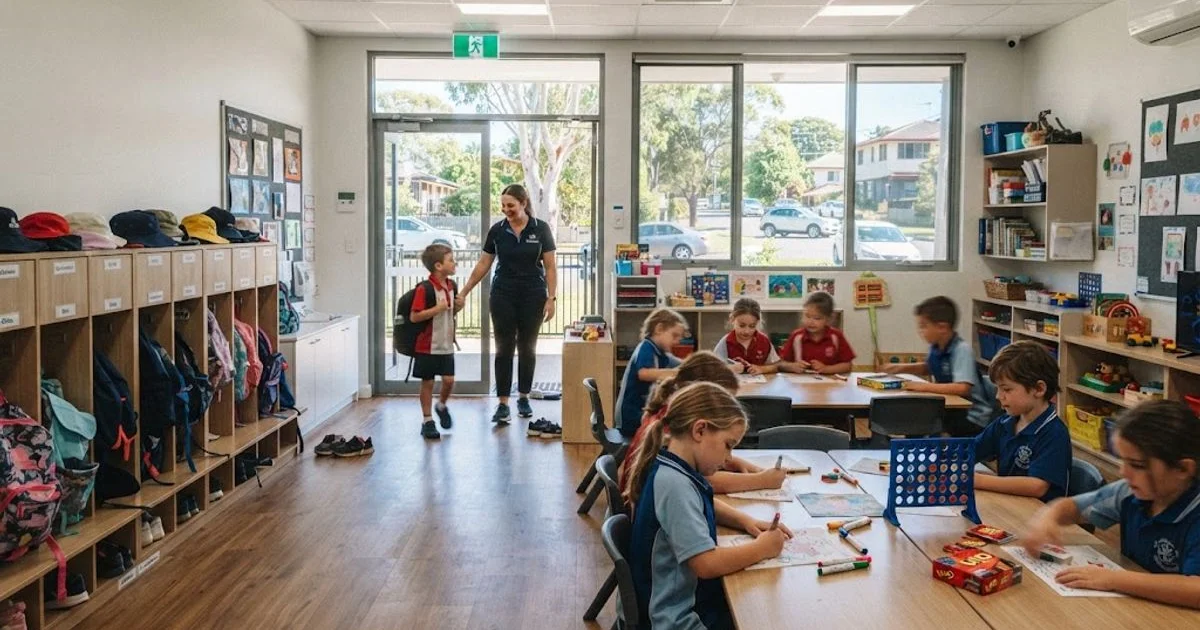
Before and after school care covers the hours either side of the school day, during term. This guide covers term time only: hours, how children move between class and care, what the program is built on and how the Child Care Subsidy applies. School holidays have their own guide.
Before and after school care, also called outside school hours care (OSHC), looks after school-age children before the bell and after it in term time. The Child Care Subsidy applies to approved OSHC, with an hourly rate cap of $13.30 for school-age children from 6 July 2026 (Services Australia). In our directory, the 1 dedicated outside school hours care listing shows 6:30am to 8:50am and 3:00pm to 6:00pm on weekdays (Google hours, checked 8 November 2026).
Before and after school care hours
Before and after school care runs in 2 blocks a day: a morning session that ends at the school bell and an afternoon session that starts when school finishes. The block times come from the school’s day. They differ from the 6:00am to 6:30pm day a long day care centre offers. The dedicated listing in our directory shows 6:30am to 8:50am and 3:00pm to 6:00pm, Monday to Friday, with the weekend closed (Google hours, checked 8 November 2026). That is 1 listing, so treat it as an example and confirm hours with your own school’s service.
Check 3 times before you book: the first time you can drop off, the time the afternoon session ends, and the fee for a late pick-up.
How do children get from class to the care room?
Ask 4 questions about the handover between classroom and care room, because how children travel depends on where the service runs.
- Does the service run on the school grounds or somewhere else?
- Who collects my child from class, and is that a group walk or an individual pick-up?
- What happens if my child is not where they should be at the afternoon bell?
- How do you sign children out, and who may collect them?
Educator numbers matter here as well. In Queensland the minimum ratio for children over preschool age is 1 educator to 15 children, and a child in Prep or above counts as over preschool age (National Regulations, regulations 4 and 123). Queensland adds a qualification rule for school-age care in the National Regulations: at least 1 educator must hold, or be working towards, a relevant qualification of at least 2 years.
A blue card is needed by educators and by most other adults who enter while children are there (Queensland Government).
My Time, Our Place explained
My Time, Our Place is the approved learning framework for school age care in Australia, and the current version is V2.0, published in 2022 (ACECQA). A before and after school care service must deliver a program based on an approved framework, and it is assessed and rated against the National Quality Standard’s 7 quality areas (ACECQA).
Ask the service to show you its program. Ask how children choose what they do. A service that can show a recent program is easier to judge than a service that describes the framework in general terms.
How does the Child Care Subsidy apply?
Outside school hours care is an approved care type for the Child Care Subsidy, and it includes before school, after school and vacation care. From 6 July 2026 the hourly rate cap is $13.30 for school-age children and $15.19 for children below school age. A child counts as school aged if they are in school or aged 6 or older (Services Australia).
Your subsidy percentage applies to the lower of the service’s hourly fee or the cap. The standard rate is 90% for family income up to $88,520, and it falls by 1 percentage point for every $5,000 above that, reaching 0% at $538,520 (Services Australia). The 3 Day Guarantee of at least 72 subsidised hours per child per fortnight applies to OSHC as well (Department of Education).
Our guide to the subsidy percentage and your gap fee explains how a percentage becomes a gap fee, and the childcare cost estimator shows the weekly figure.
How bookings work
Bookings for before and after school care follow each service’s own rules, so ask 3 things before you enrol: whether you book set days or can add casual sessions, how much notice a change needs, and what the service charges when a child is absent. Ask for the fee schedule in writing, including any enrolment fee. Some services charge an enrolment fee, so ask.
If your child has asthma, an allergy or another medical condition, tell the service when you enrol. Its medical conditions policy must require you to provide a medical management plan, and the service must develop a risk minimisation plan with you (National Regulations, regulations 90 and 91).
A charge for an absent day is the service’s own policy, and the subsidy only helps when a fee is charged. You can get up to 42 allowable absence days per child each financial year, for any reason (Services Australia).
Pupil-free days and public holidays can fall inside the school year. Ask whether the service opens on them and how they are charged. For school holidays, read planning vacation care for the school year.
What should your child bring?
Sun protection matters at any session that goes outside. In Queensland the UV Index is 3 or above all year round, so children need it every day, not only in summer (Queensland Government). Every service must have a sun protection policy, so ask what it expects your child to bring, such as the broadbrim or bucket style hat that covers the head, neck and ears which the Queensland Government recommends (Heat and sun safety).
The National SunSmart Program, run by Cancer Council Queensland, recognises outside school hours care services that apply with a written sun protection policy. A SunSmart sign is recognition, not a legal requirement (Cancer Council Queensland).
What changes when your child starts Prep?
A child starting Prep meets a new school day and a new care routine in the same weeks. Prep is the first year of school in Queensland, and a child must be 5 by 30 June in the year they enrol (Queensland Government). For the ratio, the National Regulations count a Prep child as over preschool age, so the 1 to 15 school-age rule applies.
Ask the service whether Prep children get a settling plan, which educator will meet them at class and how the service handles a tired child who needs a quiet space.
Common questions
- What are typical before and after school care hours?
- Services run a morning session ending at the school bell and an afternoon session from the end of the school day. The dedicated outside school hours care listing in our directory shows 6:30am to 8:50am and 3:00pm to 6:00pm on weekdays (Google hours, checked 8 November 2026). It is only 1 listing, and hours differ by service, so confirm the first drop-off time and the end of the afternoon session.
- Does the Child Care Subsidy apply to before and after school care?
- Yes. Outside school hours care is an approved care type for the Child Care Subsidy, and the 3 Day Guarantee applies to it. From 6 July 2026 Services Australia sets the hourly rate cap at $13.30 for school-age children and $15.19 below school age. Your percentage applies to the lower of the service's fee or the cap, so ask each service for its hourly fee.
- What framework do before and after school care services follow?
- According to ACECQA, they follow My Time, Our Place: Framework for School Age Care in Australia, V2.0, published in 2022, which is an approved learning framework under the National Quality Framework. The state regulator assesses and rates services against the National Quality Standard's 7 quality areas. Ask a service to show you its current program and how children choose their activities.
- How many children can one educator supervise in before and after school care?
- Under the National Regulations the Queensland minimum ratio for children over preschool age is 1 educator to 15 children, and a child in Prep or above counts as over preschool age. At least 1 educator must also hold, or be working towards, a relevant qualification of at least 2 years. Ask the service how many children attend on your child's days.